The ATO doesn't set one blanket depreciation rate for every item in a rental property. Instead, it publishes an effective life for many depreciating assets, such as appliances, carpet and hot water systems. Broadly, effective life is the period an item can be used to produce income (or for certain other purposes), by any owner, not just you. It determines the rate used in the calculation. What you can actually deduct also depends on the method, the item's cost, how long you've held it and the tax rules.
There are two methods, and one is chosen for each asset. Prime cost spreads the claim evenly. Its yearly rate is 100% divided by the effective life. Diminishing value claims more in the early years. Its rate is 200% divided by the effective life, or 150% for assets you started holding before 10 May 2006. Take a carpet with an 8 year effective life. Its calculation rate is 12.5% a year under prime cost, or 25% under diminishing value. A rate isn't a promise of what you can deduct. That depends on whether the item qualifies and how the property is used.
Two things tend to catch property investors off guard. First, the effective life that applies generally depends on when you acquired the item. If it came with the property, that's usually when you bought the property. If you put it in later, it's when you bought the item. (We cover the exact rule a bit further down.) Several effective lives were shortened for items acquired from 1 July 2019. Second, some things investors expect to claim as separate items, like hot water piping or fixed floor tiles, are generally treated as capital works instead. Capital works covers the building's structure and certain fixed parts of it.
The tables below cover the items we see most often across residential rental properties, grouped by room and area. Jump to:
- The effective life tables
- Why the purchase date matters
- Items treated as capital works
- Whether these rates apply to your property
How do you turn an effective life into a depreciation rate?
The ATO sets out both formulas on its prime cost and diminishing value methods page:
- Prime cost: asset's cost × (days held ÷ 365) × (100% ÷ effective life)
- Diminishing value: base value × (days held ÷ 365) × (200% ÷ effective life)
The ATO calls each year's depreciation amount the item's decline in value. Base value is generally the item's cost less its decline in value in earlier years, plus any later costs such as improvements. Prime cost generally gives the same deduction each full year. It's adjusted for days held in a part year and for any change to the asset's cost. Diminishing value gives you bigger claims early on and smaller ones later, because the rate applies to a balance that shrinks each year. If you started holding an asset before 10 May 2006, the diminishing value formula uses 150% rather than 200%.
To see how this works in practice, picture a split system air conditioner costing $2,400, held for a full year and used only for the rental. These are illustrative figures only.
| Split system, $2,400, 10 year effective life | Prime cost (10%) | Diminishing value (20%) |
|---|---|---|
| Year 1 calculation | $240 | $480 |
| Year 2 calculation | $240 | $384 |
| Year 3 calculation | $240 | $307 |
We've covered how the two methods compare over time, and how low-value pooling works, in How your depreciation estimate is calculated.
ATO effective lives for common rental property items
These effective lives come straight from the ATO's Rental properties 2026 guide, residential rental property items. The rates are the annual percentages that follow from each life. Where the ATO labels an item "own estimate", there's no Commissioner's determination for it. The life then has to be worked out using the tax rules and the item's own circumstances.
Before reading through the tables, keep this in mind. The percentages simply show the annual rate that flows from each item's effective life. They don't confirm that an item is deductible in your situation. Whether you can claim depends on things like when and how you acquired the item, and how the property is used. It also depends on whether the item was already in the property when you bought it (see "Do these rates apply to every rental property?" below). This is also just a selection of the most common items, not the complete ATO list.
How to read the tables: each rate is listed as diminishing value first, then prime cost. For assets you started holding from 10 May 2006 onwards, the prime cost rate is half the diminishing value rate. The lives listed apply to items acquired from 1 July 2019, unless another date is noted. The common items whose life changed on that date are covered in the next section. Some items also carry different lives for earlier periods, so check the ATO tables for the date that applies to you.
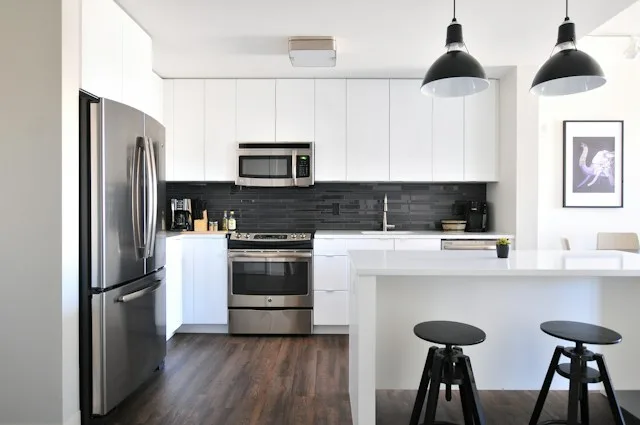
In the kitchen
The 2019 changes hit two common kitchen appliances. Dishwashers and microwaves both dropped from a 10 year to an 8 year life for items acquired from 1 July 2019. Ovens, cooktops and range hoods sit at 12 years.
| Item | Effective life | Rate (diminishing value / prime cost) |
|---|---|---|
| Ovens, cooktops and range hoods | 12 years | 16.67% / 8.33% |
| Dishwashers | 8 years | 25% / 12.5% |
| Refrigerators | 12 years | 16.67% / 8.33% |
| Microwave ovens | 8 years | 25% / 12.5% |
Laundry, bathroom and hot water
Washing machines and clothes dryers were also shortened in 2019, to 8 and 7 years. The hot water system itself is a depreciating asset, with a 12 year life for electric or gas units and 15 years for solar. The piping that runs from it is a different story: the ATO's tables treat hot water piping as capital works.
| Item | Effective life | Rate (diminishing value / prime cost) |
|---|---|---|
| Washing machines | 8 years | 25% / 12.5% |
| Clothes dryers | 7 years | 28.57% / 14.29% |
| Hot water system, electric or gas | 12 years | 16.67% / 8.33% |
| Hot water system, solar | 15 years | 13.33% / 6.67% |
| Bathroom exhaust fans | 10 years | 20% / 10% |
Floors, windows and living areas
Carpet's effective life dropped from 10 to 8 years for carpet acquired from 1 July 2019. The key distinction here is removable versus fixed. Removable floor coverings like carpet and floating timber are depreciating assets, while fixed coverings, including tiles and fixed vinyl, are generally treated as capital works. Ceiling fans have one of the shortest lives on the list at 5 years.
| Item | Effective life | Rate (diminishing value / prime cost) |
|---|---|---|
| Carpets (removable) | 8 years | 25% / 12.5% |
| Floating timber floors (removable) | 15 years | 13.33% / 6.67% |
| Internal window blinds | 10 years | 20% / 10% |
| Curtains | 6 years | 33.33% / 16.67% |
| Ceiling fans | 5 years | 40% / 20% |
Heating and cooling
For air conditioning, the unit and the ductwork are treated separately. A split system unit has a 10 year life. But the ATO's tables treat the ducts, pipes and vents in a ducted system as capital works, not depreciating assets. Gas ducted central heating carries a 20 year life, one of the longest in this list.
| Item | Effective life | Rate (diminishing value / prime cost) |
|---|---|---|
| Split system air conditioner (up to 20kW) | 10 years | 20% / 10% |
| Fixed electric heaters | 15 years | 13.33% / 6.67% |
| Gas ducted central heating | 20 years | 10% / 5% |
Outside
Water pumps saw the biggest 2019 changes of any item in this post. A rainwater tank pump acquired from 1 July 2019 has a 5 year life, down from 20. The ATO lists a solar-powered generating system, including its panels, inverters, batteries and regulators, as one asset with a 20 year life. If there's a pool, the ATO's tables treat the pool itself as capital works and the filtration equipment that runs it as a depreciating asset.
| Item | Effective life | Rate (diminishing value / prime cost) |
|---|---|---|
| Garage door motors | 10 years | 20% / 10% |
| Solar-powered generating system (panels, inverters, batteries, regulators) | 20 years | 10% / 5% |
| Water pump, single residence pressure | 8 years | 25% / 12.5% |
| Water pump, rainwater tank | 5 years | 40% / 20% |
| Pool filtration (including pumps) | 10 years | 20% / 10% |
The split system life applies to units acquired from 1 July 2003, and the pool filtration life to equipment acquired from 1 July 2004. For vinyl floor coverings, light shades, garbage disposal units, intercoms, furniture and other pool equipment, see the ATO's full residential rental property items tables.
Why does the purchase date of an item change its rate?
The ATO's Guide to depreciating assets 2026 sets out the general rule. You generally lock in the effective life in force when you enter into a contract to acquire the asset, otherwise acquire it, or start constructing it. There's a five-year catch. If the item isn't used, or installed ready for use, within 5 years of that time, the life in force at that later point generally applies instead. That's why two identical items in the same property can depreciate at different rates if they were bought on opposite sides of a change.
The 1 July 2019 changes show how this plays out. Take an illustrative $1,200 dishwasher that you bought new and installed yourself, held for a full year and used only for the rental. Using the diminishing value method:
- Acquired in 2018, it carries a 10 year life, so the year one calculation is $240.
- Acquired in 2020, it carries an 8 year life, so the year one calculation is $300.
Whether that calculated amount can actually be deducted depends on eligibility and the usual rules.
It's not just dishwashers either. These are the common rental items whose effective life was shortened for items acquired from 1 July 2019:
| Item | Acquired 1 July 2004 to 30 June 2019 | Acquired from 1 July 2019 |
|---|---|---|
| Carpets (removable) | 10 years | 8 years |
| Dishwashers | 10 years | 8 years |
| Microwave ovens | 10 years | 8 years |
| Washing machines | 10 years | 8 years |
| Clothes dryers | 10 years | 7 years |
| Water pump, single residence pressure | 20 years | 8 years |
| Water pump, rainwater tank | 20 years | 5 years |
That's why an item's acquisition date matters: a change to its effective life changes how quickly its value is written off for tax.
What if your item isn't listed here?
You can browse the ATO's full residential rental property items tables, which list far more items than we've included here. If an item isn't listed, or says "own estimate", its life has to be worked out using the tax rules and the item's own circumstances, rather than as an arbitrary figure. We explain how below.
Which determination sets the effective lives now?
The Commissioner's effective lives are now made under the Income Tax Assessment (Effective Life of Depreciating Assets) Determination 2025 (F2025L01097). That instrument repealed the Income Tax (Effective Life of Depreciating Assets) Determination 2015 on 16 September 2025, according to the Federal Register of Legislation.
The ATO described the changeover as "purely administrative" for businesses. It also said TR 2022/1, the ruling that previously contained the effective life tables, would be withdrawn at the end of October 2025. It said there were no changes to how you apply the rules (ATO, final guidance on effective life of assets). For current effective lives, use the 2025 instrument and the ATO's current guidance rather than TR 2022/1. The switch to the new instrument doesn't reset the effective life of items you already own. As mentioned above, the life that applies generally depends on the rules in force when the item was acquired or construction began. The five-year rule and other exceptions still apply.
Can you use your own effective life instead of the ATO's?
For most depreciating assets, you can generally choose between the Commissioner's effective life and your own estimate, subject to the restrictions in the tax law. Those restrictions can depend on the asset and when it was acquired. In some cases, the effective life can be recalculated later. You can choose to do this if a change in how the item is used means the life you've been using is no longer accurate. In other cases, such as some cost increases of 10% or more, recalculating is required. The tax rules set out when each applies.
For items marked "own estimate" in the ATO tables, there's no Commissioner's figure to fall back on, so the life has to be estimated. Working through those items one by one is a big part of what a quantity surveyor does when preparing a depreciation schedule.
Which rental property items aren't on the depreciation list?
Some items form part of the building itself rather than standing alone as separate assets. As a result, they're generally treated as capital works (Division 43) instead. The ATO's rental property tables list these as capital works:
- Hot water piping
- Fixed floor coverings, including tiles and fixed vinyl
- Air conditioning ducts, pipes and vents
- Swimming pools themselves (though the pump and filter are depreciating assets)
Capital works use fixed annual rates instead of effective lives, set out on the ATO's capital works deductions page. Where the requirements for a deduction are met, residential construction that started from 16 September 1987 is generally claimed at 2.5% a year over 40 years. Eligible construction that started between 18 July 1985 and 15 September 1987 may qualify for 4% a year over 25 years. Our guide to Division 40 vs Division 43 breaks down the difference in more detail.
Do these rates apply to every rental property?
Not in every case. The rules changed for established residential rental properties acquired after 7:30pm AEST on 9 May 2017. For those, deductions for the decline in value of certain second-hand depreciating assets already in the property are generally restricted, unless an exception applies. That restriction doesn't touch capital works claims. It also doesn't block deductions for eligible new items you buy and install yourself later, subject to the usual rules.
The ATO's second-hand depreciating assets page lists key exceptions, including:
- property that isn't used for residential accommodation, such as commercial property
- investors carrying on a business of letting rental properties
- certain entities, such as companies, public unit trusts, managed investment trusts and super funds other than SMSFs.
The rule specifically targets items that another owner had already used or installed ready for use. Because eligibility hinges on who owns the property and each item's history, checking these details is a core step in preparing a schedule. We explain how this works in Can you claim depreciation on a second-hand or older property?
How do you find out what your property's items are actually worth?
The tables give you the rate, but they won't show what each item actually cost, whether it qualifies, or which parts belong under capital works. Those are what set the dollar figure. A quantity surveyor's depreciation schedule sets out each item's estimated value and effective life, alongside the capital works amounts. Your accountant then uses it to work out what you can claim. The ATO recognises quantity surveyors as appropriately qualified to estimate construction costs where the actual costs aren't known (TR 97/25). On its capital works deductions page, the ATO also says the fee you pay to obtain that estimate can be claimed as a deduction. Your accountant can confirm how that applies to you.
To get a starting idea for your property, try our tax depreciation calculator, or request a quote for a full schedule. The calculator gives an indicative estimate only. It doesn't replace an inspection or a depreciation schedule.
Common questions
What is the ATO effective life of carpet in a rental property?
Removable carpet acquired from 1 July 2019 has an 8 year effective life, down from 10 years. That gives a rate of 25% a year under diminishing value or 12.5% under prime cost.
How do you work out a depreciation rate from an effective life?
Prime cost uses 100% divided by the effective life, and diminishing value uses 200% divided by the effective life. For assets you started holding before 10 May 2006, diminishing value uses 150% instead.
Does the purchase date change an item's effective life?
Yes. You generally lock in the effective life in force when you contract to acquire, otherwise acquire, or start constructing the item, so items bought either side of a change such as 1 July 2019 can carry different lives.
Are hot water piping and floor tiles depreciating assets?
No. The ATO's rental property tables treat hot water piping, fixed floor coverings such as tiles and fixed vinyl, and air conditioning ducts, pipes and vents as capital works. Residential construction that started from 16 September 1987 is generally claimed at 2.5% a year over 40 years.
Can I claim depreciation on items already in an established rental property?
For established residential rental properties acquired after 7:30pm AEST on 9 May 2017, deductions for second-hand depreciating assets already in the property are generally restricted unless an exception applies. That restriction doesn't affect capital works claims or eligible new items you buy and install yourself.
TDA prepares depreciation schedules and doesn't provide tax or financial advice. This article is general information only and isn't tax advice. The effective lives and rates in it don't establish whether a particular item qualifies for a deduction, or how much can be claimed in any individual case. Effective lives and rates are taken from ATO guidance current at 14 October 2026. Figures in the examples are illustrative, assume a full year of ownership, and aren't a prediction of any individual claim. Speak to your accountant about your own circumstances.